
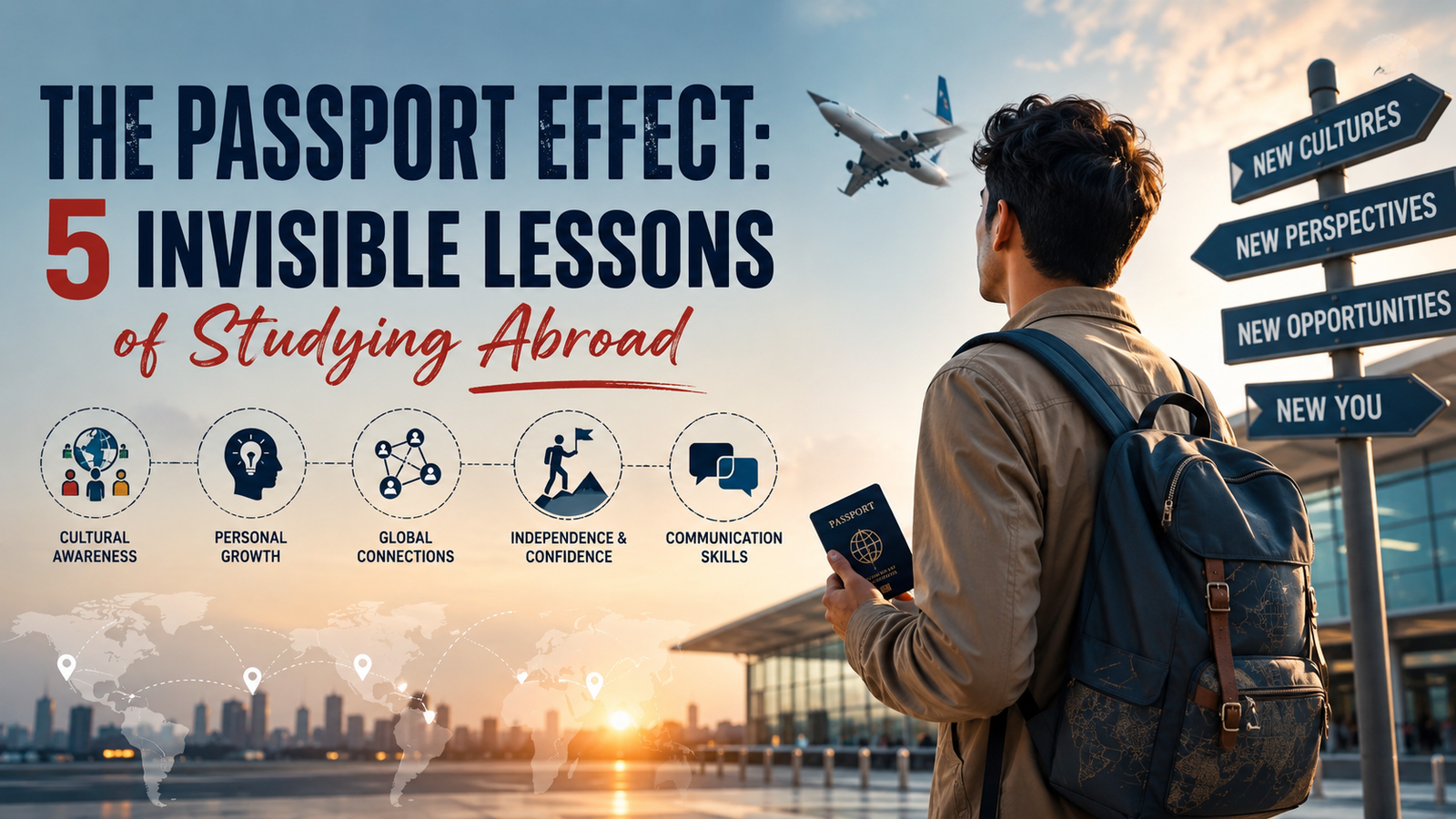
The Passport Effect: 5 Invisible Lessons of Studying Abroad
When you pack your bags for an international university, the checklist is predictable: student visa, financial statements, winter clothing, and a crisp new passport. University brochures promise world-class infrastructure, exceptional faculty, and a global network that will skyrocket your career. While all of that is true, the real education of studying abroad doesn’t happen inside the lecture halls. It doesn’t come with a syllabus, and it certainly won’t be tested on a final exam.
There is a profound, silent transformation that occurs the moment you step off the plane in a country where you don’t know the local grocery store layout, the transit system, or the unspoken social rules. This is what we call The Passport Effect. It is the invisible curriculum of international education—a collection of deep, internal shifts that reshape how you think, react, and exist in the world.
Here are the five invisible lessons of studying abroad that no university brochure will ever tell you.
1. The Discomfort Threshold (Learning to Love Being Clueless)
Back home, your life has a rhythm. You know exactly how to order your coffee, how to navigate difficult bureaucratic systems, and what tone of voice to use when you’re frustrated. You operate on autopilot. When you move abroad, that autopilot is instantly shattered.
Suddenly, the simplest tasks turn into monumental challenges. Buying the wrong type of milk because you couldn’t decipher the label, getting on the wrong train and ending up at the end of a rural line, or misinterpreting a local gesture are rites of passage. In the beginning, these moments feel deeply embarrassing. They make you want to retreat to your dorm room and call home.
But then, an invisible shift occurs. You build a tolerance for ambiguity. You realize that making a fool of yourself isn’t fatal; it’s just data collection. You stop panicking when things go wrong and instead learn to ask, “Okay, what’s the workaround here?” This elevated discomfort threshold is arguably the greatest life tool you can acquire. While others freeze in the face of unpredictable changes in their careers or personal lives, a study abroad alumnus smiles, adapts, and figures it out. The classroom teaches you facts about the world; the street corners of a foreign city teach you how to survive inside it.
2. The Unbundling of Cultural Identity
We rarely think about our own culture when we live inside it. It is like fish trying to describe water—it is simply everything around us. However, when you are dropped into a completely different cultural ecosystem, your native habits, values, and assumptions are suddenly thrown into sharp relief.
You begin to notice things you took for granted. Why do people from your home country communicate so indirectly? Why is your concept of time so rigid—or so loose—compared to the locals here? For the first six months, you might find yourself constantly comparing and judging. But as time wears on, you stop seeing things as ‘right’ or ‘wrong’ and start seeing them simply as ‘different.’
This process is what psychologists call cultural unbundling. You begin to consciously choose which parts of your native culture you want to keep and which elements of your host culture you want to adopt. You aren’t just copying the locals; you are deliberately curation-building your own personality. You return home with a hyphenated identity—a mosaic of perspectives that allows you to see the world through multiple lenses simultaneously.
3. The Art of the Micro-Community
University marketing materials love to show photos of incredibly diverse groups of students sitting on pristine lawns, instantly laughing like lifelong friends. The reality of building a social circle from scratch in a foreign country is far more vulnerable, raw, and slow.
When you study abroad, you leave behind your built-in safety net of childhood friends, family members, and familiar faces who understand your history. You start with a blank slate. This forces you to learn how to manufacture intimacy and build what can be called micro-communities. You learn to connect with people not because you share a childhood neighborhood or a language, but because you share a mutual vulnerability in that exact moment.
You form deep bonds over shared cooking experiments, late-night cram sessions in unfamiliar libraries, and the quiet comfort of navigating loneliness together. You learn the social mechanics of reaching out, reading people across cultural barriers, and showing up for others when they need a piece of home. This teaches you how to build a community anywhere in the world—a skill that prevents you from ever truly being isolated, no matter where your career takes you.
4. Depprogramming the “Timeline” Obsession
Most students go through life on a very strict, socially engineered track: high school, university, internship, graduation, corporate job, promotion. There is a quiet, underlying anxiety that if you take a wrong turn or pause for a second, you will fall hopelessly behind your peers.
Chasing this timeline becomes exhausting. Fortunately, studying abroad breaks this linear illusion. On an international campus, you rub shoulders with people whose life paths look entirely different from yours. You might meet a 26-year-old undergraduate from Scandinavia who spent three years working on a farm before starting college, a classmate from South America who is balancing a startup with their master’s degree, or a local student who views success not through a corporate title, but through work-life balance and creative freedom.
Exposure to these alternative narratives deprograms your timeline obsession. You realize that the race you thought you were running is entirely fictional. This invisible lesson frees you from peer pressure. It gives you the psychological space to breathe, pivot, take career risks, and realize that your twenties and thirties are a playground for exploration, not a checklist to be rushed through.
5. Radical Self-Reliance (The Solo Monologue)
There is a specific moment that every single study abroad student experiences. It usually happens about three or four weeks into the semester. The initial excitement of the new city has faded, the university orientation events are over, and you are sitting alone in your room on a rainy Tuesday evening facing a domestic crisis—perhaps a broken radiator, a sudden illness, or a mountain of bureaucracy written in a language you don’t master.
In that exact moment, you look around the room and realize a profound truth: No one is coming to fix this for me. Your parents are thousands of miles away in a different time zone, and your new friends are busy with their own lives. You are completely on your own.
Anxiety hits first, but it is quickly followed by action. This realization is the ultimate catalyst for radical self-reliance. You pick up the phone, use translation apps, deal with the landlord, nurse yourself back to health, and resolve the problem.
When you handle these moments successfully, something shifts inside your core. You stop fearing emergencies. You develop a deep, unshakeable confidence in your own ability to figure things out. This internal resilience is the ultimate gift of the passport effect; you realize that your ultimate home isn’t a physical place, but your own capability.
The Invisible Return
When your studies conclude and you finally pack your bags to head home, your passport will be stamped, your suitcase will be heavier, and you will hold a hard-earned degree in your hands. Your friends and family will ask you how the trip was, expecting stories of famous landmarks, weekend getaways, and exotic foods.
You will smile and share those stories. But as you do, you will realize that the most important changes are the ones they cannot see. They won’t see the threshold of discomfort you conquered, the cultural nuance you absorbed, or the radical self-reliance you forged in isolation.
You left as a student looking for a qualification; you return as an entirely redefined human being who is ready to handle whatever the world throws your way. That is the true Passport Effect.