
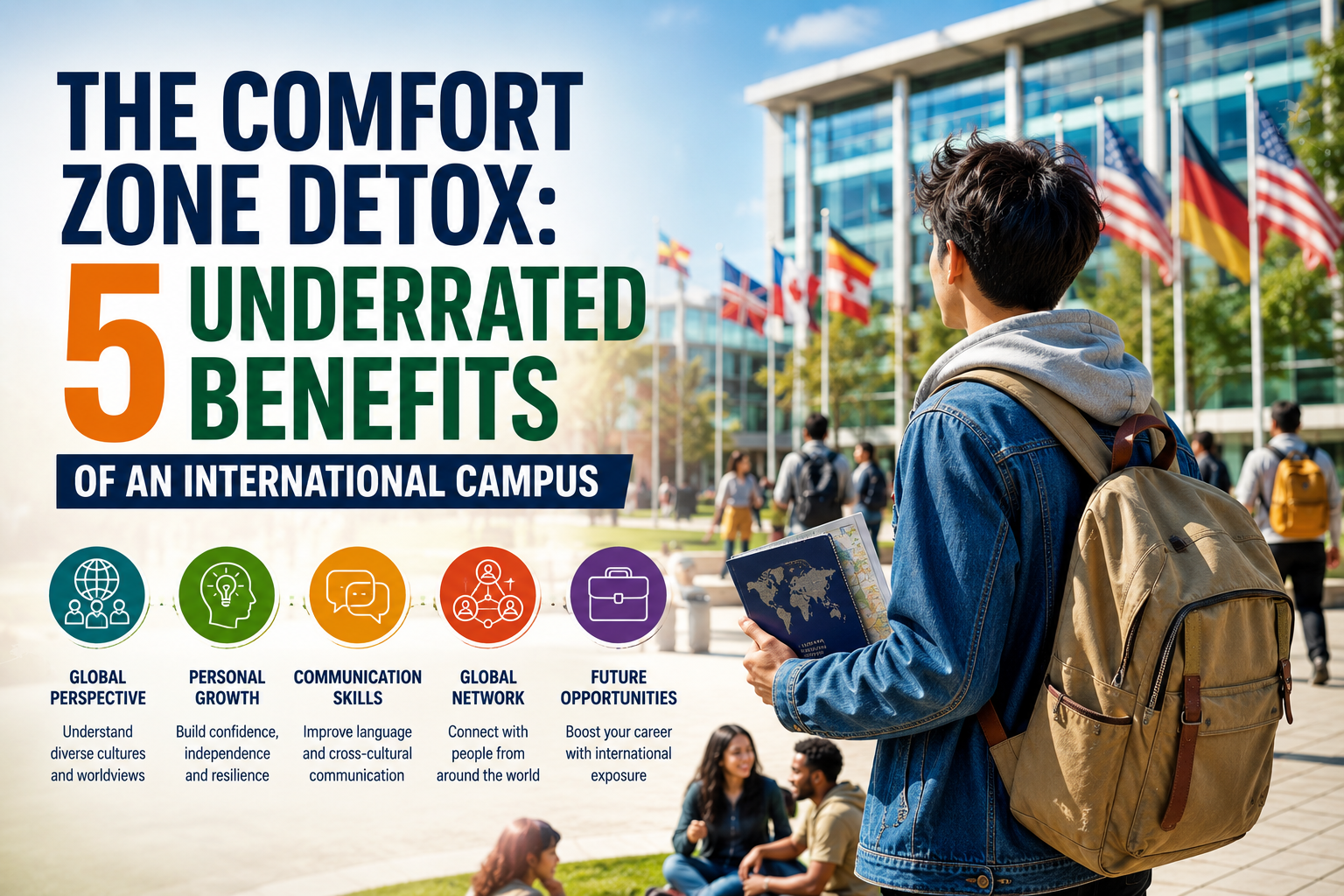
The Comfort Zone Detox: 5 Underrated Benefits of an International Campus
Human beings love predictability. We build patterns, settle into routines, and unconsciously surround ourselves with people who talk like us, laugh at the same jokes, and share our worldview. It’s warm, safe, and incredibly cozy. But safety has a quiet side effect: it makes us soft. When nothing challenges your day-to-day assumptions, your personal growth stalls out. You stop updating your mental software because the current version works just fine for your immediate, familiar surroundings.
Choosing to study on an international campus is less about picking a location for a degree and more about signing up for a massive, voluntary shock to your entire system. It is a psychological intervention. We can call it The Comfort Zone Detox. When you move to an environment where your baseline assumptions no longer apply, you flush out old, stagnant habits and replace them with mental agility.
While university rankings focus heavily on research funding, campus infrastructure, and professor citations, the real gold lies in the hidden side effects of navigating a global student body. Here are five deeply underrated benefits of this cultural detox.
1. The Loss of “Main Character” Syndrome
Back home, whether you realize it or not, you carry a specific social currency. You understand the local slang, you know exactly where you fit in the social pecking order, and you carry the invisible privilege of being a native. You are, in your own mind, the default character in the story. Everyone else is just background noise or supporting cast.
The moment you step onto a truly international campus, that illusion evaporates. You look around a dining hall or a lecture theater and realize you are surrounded by hundreds of other “main characters” from every corner of the planet. There is the student who survived an economic collapse in South America, the tech prodigy from East Asia, and the activist from a tiny island nation fighting rising sea levels. Each of them brings a life narrative that is just as complex, urgent, and rich as yours.
Initially, this can feel a bit bruising for the ego. You realize you aren’t quite as unique or central to the universe as your hometown circle made you feel. But this realization is incredibly liberating. It strips away arrogance and replaces it with genuine curiosity. You learn to listen without simply waiting for your turn to speak. You stop trying to dominate the room and instead focus on learning from it. Growth doesn’t happen when you find yourself; it happens when you realize how much of your identity was just a product of your zip code.
2. Developing a High-Definition Bullshit Detector
Living in one country usually means consuming one primary brand of media, political bias, and national narrative. You learn what to fear, what to value, and who the “good guys” and “bad guys” are based on the news channels and social feeds of your home country. It’s an insulated bubble where opinion easily masquerades as objective, universal fact.
An international campus ruins this bubble forever. When a global crisis or major political event occurs, you don’t just watch it as an abstract report on a screen. You sit across the kitchen table from roommates who are directly affected by it. You hear three completely conflicting perspectives on the exact same historical event from classmates who were taught entirely different versions of history in their respective schools.
This exposure deprograms your naivety. You start looking at information critically, questioning motives, and realizing that truth is rarely simple or one-sided. Your brain develops a high-definition filter for propaganda and easy answers. You stop being easily manipulated by sensational headlines because you’ve learned to ask: “Whose perspective am I missing here?” This critical independent thinking makes you highly resilient and valuable in any complex, modern professional environment.
3. Mastering “No-Context” Communication
When you speak to someone from your own culture, your communication relies heavily on shared context. You can use half-sentences, regional references, specific pop-culture jokes, and a certain tone of voice, knowing the other person will automatically fill in the gaps. It requires very little mental effort.
On an international campus, this shorthand fails completely. If you tell a hyper-local joke or use heavy slang in a group containing a Nigerian, a Japanese, and a German student, you will likely be met with polite, blank stares. You are forced to communicate with zero baseline context.
This teaches you the subtle art of intentional communication. You learn to strip away confusing idioms, think about your word choices, monitor your speed, and watch for genuine comprehension rather than assuming it. More importantly, you learn to read non-verbal cues with incredible accuracy—noticing the slight hesitation in a nod or the confusion behind a polite smile. By the time you graduate, you have inadvertently developed world-class communication skills. You become the rare person who can walk into a boardroom of international stakeholders, pitch an complex idea, and make everyone feel aligned.
4. The Deconstruction of Everyday Fear
Anxiety thrives on the unknown. Before you leave your home country, your brain constructs a massive wall of micro-fears: What if I can’t find food I like? What if the locals are hostile? What if I get terribly sick? What if I completely fail to fit in? We project our insecurities onto foreign spaces, imagining them as cold and uninviting.
The detox treats this anxiety by bombarding you with real-world evidence to the contrary. You learn that human kindness looks remarkably similar everywhere. You find out that the local shopkeeper who doesn’t speak a word of your language will still go out of their way to help you find the right bus. You discover that a hot bowl of soup from a completely unfamiliar culture can feel just as comforting as your family’s cooking when you have a bad cold.
Every time you navigate an awkward situation or receive unexpected kindness from a stranger, a brick falls out of that wall of fear. You stop viewing the world outside your borders as a dangerous place to be managed and start seeing it as a space to be explored. This leaves you with an underlying sense of calm. When you aren’t constantly managing irrational fears about the unknown, you save an enormous amount of mental energy that can be channeled into creativity and ambition.
5. The Upgrade from Networking to Kinship
The corporate world talks endlessly about “networking.” We are told to collect LinkedIn connections, swap business cards at awkward mixers, and build transactional relationships that might come in handy for a future job application. It feels mechanical, hollow, and often exhausting.
What happens on an international campus is the exact opposite of cold networking—it is the creation of cross-border kinship. When you share a small, overheated kitchen with people during a brutal winter, cook chaotic meals together using whatever ingredients you can afford, and stay up until 3:00 AM debating philosophy or sharing family secrets, you aren’t building a network. You are building emotional infrastructure.
These bonds are uniquely durable because they are forged during a period of intense, mutual vulnerability. Years down the line, these classmates won’t just be contacts in an address book to ping for a favor; they will be the people whose couches you can crash on in London, Tokyo, or Nairobi. You gain a global footprint built on genuine affection rather than professional utility. This makes the world feel smaller, safer, and infinitely more welcoming.
The New Baseline
The comfort zone is a beautiful place, but nothing ever grows there. When your time on an international campus comes to an end, you don’t just return with a degree certificate and a scrapbook of memories. You return with an entirely overhauled nervous system.
You will find that things which used to stress you out—unexpected plan changes, difficult conversations, unfamiliar environments—no longer shake your foundation. You’ve been through the detox. You have learned to sit comfortably with ambiguity, to look past cultural barriers, and to trust your own feet on unfamiliar ground. The university degree gets your foot in the door, but it is this internal rewiring that determines how far you walk once you are inside.