
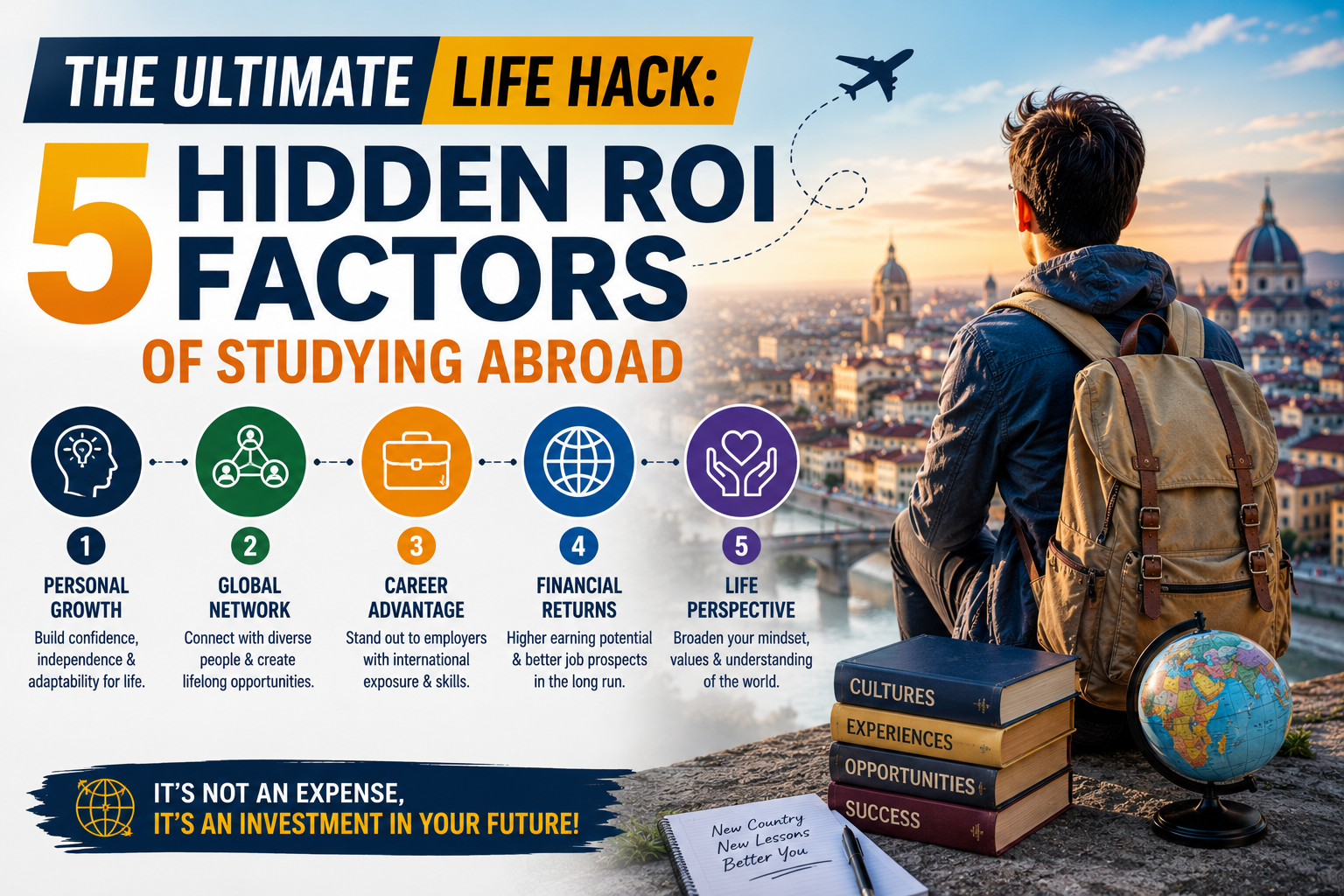
Whenever families sit down to discuss the prospect of studying abroad, the conversation almost always revolves around a massive Excel sheet. On one side, there is the eye-watering cost of tuition, international flights, accommodation, and health insurance. On the other side, there is the projected starting salary of a graduate working in a global city. This is how most people calculate the Return on Investment (ROI) of an international degree. It’s a simple math problem: dollars spent versus dollars earned.
But viewing an international education strictly through the lens of a tuition-to-salary ratio is a massive strategic mistake. It’s like buying a smartphone and using it only to make phone calls. You are completely missing the hidden features.
The real value of studying abroad doesn’t show up in your first paycheck. Instead, it operates as a long-term compound interest engine for your life. It is, in the truest sense, the ultimate life hack. If you look beneath the surface of the standard academic curriculum, you will find hidden assets that pay dividends for decades. Here are the five hidden ROI factors of an international campus that no financial advisor or university agent will ever calculate for you.
1. Arbitrage of Perspective (The Intellectual Monopoly)
In the world of finance, arbitrage means buying an asset in one market at a low price and instantly selling it in another market at a higher price due to a price mismatch. When you study abroad, you develop an intellectual version of this: an arbitrage of perspective.
When you grow up and study in just one country, your problem-solving framework is limited to local methodologies. You look at business, technology, and social issues through a single, crowded lens. However, when you step onto a global campus, you are exposed to completely different systems of execution. You learn how European countries approach sustainability, how Asian nations optimize hyper-efficiency, or how North American institutions cultivate aggressive entrepreneurship.
When you return to your home market—or transition into a global corporate role—you suddenly possess a localized monopoly on international insights. You can look at a problem that is baffling your local peers and say, “When I was in Germany, they solved this exact infrastructure issue by doing X, Y, and Z.” You aren’t necessarily smarter than your colleagues; you simply have access to a broader database of solutions. This perspective arbitrage makes you an invaluable strategic asset to any company, allowing you to leapfrog up the corporate ladder at a pace that standard graduates cannot match.
2. The Premature Aging of Your Crisis Management Reflex
In your twenties, the trajectory of your career is rarely determined by how well you perform when things are going smoothly. It is determined by how you react when the system breaks down. Most young professionals entering the workforce have highly fragile crisis management systems because their lives have been carefully curated and cushioned by their local support networks.
When you study abroad, your crisis management reflex undergoes an accelerated maturation process. You are forced to deal with high-stakes, confusing situations in a foreign language and under unfamiliar legal frameworks. Whether it is navigating a complex health emergency, disputing an unfair housing contract with a local landlord, or managing a sudden financial shortfall due to currency fluctuations—you have to solve it yourself.
This is the hidden ROI of stress. By the time you enter the professional workforce, your panic threshold is significantly higher than that of your peers. While a corporate crisis might cause a standard rookie employee to experience a meltdown, a study abroad alumnus remains calm. You’ve already handled a bureaucratic nightmare in a foreign country; a delayed product launch or a difficult client meeting is nothing by comparison. This psychological resilience is a premium corporate asset that signals executive leadership potential early on.
3. Cultural Code-Switching (The Ultimate Soft Skill)
We live in a deeply globalized economy, but human nature remains stubbornly local. A business pitch that works beautifully in New York will completely bomb in Tokyo. A management style that motivates a team in Mumbai might alienate a creative squad in Amsterdam. The modern corporate world doesn’t just need technically competent people; it desperately needs cultural translators.
Studying on an international campus forces you to master the art of cultural code-switching completely by accident. Over the course of a single semester, you learn how to collaborate with a diverse group of classmates. You figure out that you need to be direct and analytical with one peer, highly collaborative and consensus-driven with another, and deeply respectful of hierarchy with a third.
You develop a chameleonic ability to read the unwritten cultural software of human beings. In the corporate landscape, this is the ultimate hack. It allows you to build instant trust with international clients, manage cross-border teams with minimal friction, and navigate global mergers smoothly. This is a skill that cannot be automated by AI, making your professional profile incredibly secure and highly lucrative.
4. The Geographically Distributed Safety Net
When you build friendships with local students in your hometown, your social safety net is concentrated in a single geographic location. If that local economy faces a downturn or an industry stagnates, your entire network is impacted simultaneously.
An international campus completely decentralizes your human capital risk. The friends you make during your study abroad journey will eventually graduate and scatter across the globe. Ten years down the line, your casual college roommate might be a product manager in Silicon Valley, your lab partner might be a policy advisor in Singapore, and your weekend travel buddy might be managing a venture capital fund in London.
This creates a globally distributed network of high-value insiders. If you ever want to pivot your career, launch a startup in a foreign market, or need a warm introduction to an international corporate giant, you don’t need to cold-email executives on LinkedIn. You simply need to send a WhatsApp message to an old friend. The financial value of having trusted, high-level connections in multiple global economic hubs is practically immeasurable. It is a lifelong insurance policy against local economic instability.
5. The Permanent Erasure of Hyper-Local Anxiety
There is a quiet, suffocating anxiety that traps people who have never stepped outside their comfort zone. It is the fear that their hometown is the entire world, and that failing to meet the specific milestones of their local society means absolute failure. They worry endlessly about what their neighbors think, what their local peers are achieving, and whether they are falling behind on a very narrow track.
The final, and perhaps most liberating, hidden ROI of studying abroad is the permanent deconstruction of this hyper-local anxiety. When you experience the sheer scale, diversity, and chaos of the wider world, your hometown problems shrink down to their actual size.
You realize that there are a million different ways to live a successful life, thousands of cities where you can build a thriving career, and dozens of cultures where you can find a sense of belonging. This psychological freedom changes everything. It allows you to take bigger professional risks, speak up with more confidence, and design a life based on your own values rather than regional peer pressure. You stop playing a small, defensive game and start playing a global, offensive game.
The Final Balance Sheet
The next time you look at the daunting cost of an international education, take a moment to look past the immediate price tag. Do not just calculate the ROI based on your first job title or your initial monthly salary.
Look at the permanent upgrades to your character. Factor in the intellectual monopoly of your unique perspective, the maturity of your resilience, your world-class adaptability, and the global footprint of your human network.
Tuition fees are a short-term expense, but the internal transformation is a lifelong asset. Going abroad isn’t just an academic detour; it is a fundamental re-engineering of your potential. And in the grand calculus of life, that is an investment that always pays off.