
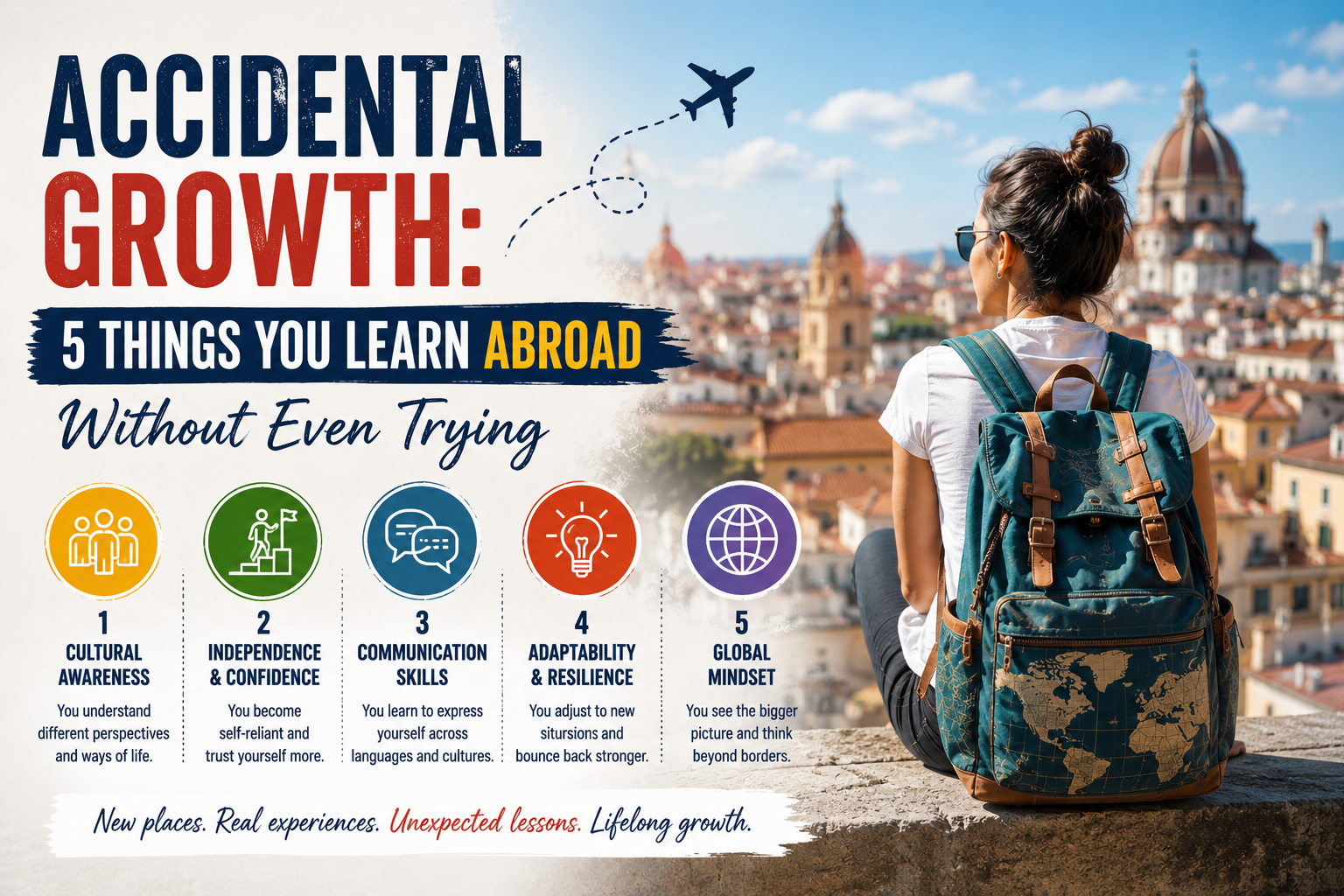
When people plan to study or live abroad, they usually create a conscious list of goals. They want to master a new language, score a high GPA, secure an internship at a multinational firm, or check off twenty different European cities from their travel bucket list. These are deliberate, calculated targets. You wake up in the morning, put in the effort, and check them off your list.
But the most profound aspects of human growth don’t work that way. They don’t announce themselves, and they certainly don’t wait for your permission.
While you are busy stressing over your university assignments or trying to figure out how the local laundromat works, something else is happening in the background. Your brain is quietly rewiring itself. Your core values are shifting. This is what we call Accidental Growth—the subconscious baseline lessons you absorb simply by existing in a foreign environment. You don’t have to try, you don’t have to study for them, and you can’t prevent them from happening.
Here are five profound things you learn abroad completely by accident.
1. The Superpower of Reading the Room (Subconscious Nuance)
Back in your home country, you are a master of context. You can read a room instantly because you understand the microscopic social cues of your own culture. You know what a specific clearing of the throat means, what a half-second delay in a text reply implies, or what a particular glance across a dinner table signifies.
When you move abroad, that cultural dictionary is useless. Suddenly, you are socially blind. A gesture that meant “yes” back home might mean “maybe” here. A tone of voice that seemed polite to you might sound aggressive to a local.
To survive, your brain automatically goes into overdrive. Without even realizing it, you start paying hyper-attention to the world around you. You look at micro-expressions, changes in posture, the spacing between people when they talk, and the specific rhythm of local conversations. You become a cultural detective out of pure necessity.
By the time a few months pass, you’ve developed an incredibly sharp intuition. You can walk into a room full of people from five different countries and immediately sense the unspoken dynamics. This isn’t a skill you studied in a textbook; it’s an accidental upgrade to your emotional intelligence that makes you an exceptional leader and collaborator for the rest of your life.
2. Radical Budgeting (The Currency Mental Matrix)
You can download all the financial tracking apps you want, but nothing teaches you the raw reality of economics quite like running out of money in a country where you don’t speak the language fluently.
When you live abroad, your brain initially does a clumsy mental dance. Every time you look at a price tag, you immediately multiply or divide it to convert it back into your home currency. “Wow, this coffee costs as much as a full meal back home!” or “This shirt is incredibly cheap compared to my city!” This constant, exhausting calculation goes on for weeks.
Then, one day, the mental matrix snaps into place without you trying. You stop converting. You start understanding the value of money relative to your current environment. You learn the exact day of the week when the local supermarket slashes prices on fresh produce. You master the art of turning three random items in your fridge into a gourmet dinner because grocery day is still forty-eight hours away.
You develop a hyper-practical, instinctual understanding of cash flow, inflation, and resource management. When you return home, you realize you’ve accidentally become a financial strategist who can manage a tight budget with absolute calm and zero panic.
3. Embracing the Freedom of Being an “Outsider”
Most of our lives are spent trying desperately to fit in. We wear the clothes our peers wear, follow the trends our society dictates, and try to live up to the expectations of our extended family and neighbors. There is a heavy, invisible pressure to conform to the local norm.
When you move to a foreign country, you are instantly labeled as an “outsider” or a “foreigner.” No matter how hard you try, how well you dress, or how perfectly you mimic the local accent, people will know you aren’t from there.
At first, this realization feels isolating. But very quickly, a beautiful, accidental liberation happens. You realize that since you can never truly blend in, the pressure to conform is completely gone.
You are finally allowed to be an anomaly. You can wear what you want, speak your mind, explore weird hobbies, and live your life without worrying about the judgment of a society that doesn’t fully understand your background anyway. You learn to stop looking outward for validation. This accidental drop in social anxiety stays with you forever. You return home with a secure sense of self, realizing that being an outsider is actually a position of immense creative strength.
4. The Realization That “Normal” is a Myth
We all grow up believing that our way of doing things is the correct, logical, default setting for humanity. The way we eat, the way we structure our family units, the way we deal with conflict, and even the way we view success—we think these are universal truths. We assume anyone doing it differently is just behaving weirdly.
Living abroad completely deconstructs this naive worldview. You watch a society function perfectly while doing the exact opposite of what you consider “normal.”
Maybe they prioritize leisure over corporate hustle, yet their economy thrives. Maybe they communicate with a level of blunt honesty that feels rude to you, yet their relationships are incredibly stable and transparent. Maybe their concept of personal space is completely different, yet their communities are beautifully tight-knit.
You don’t sit down and write an essay about cultural relativity. Instead, your brain simply absorbs the data. The walls of your mental house expand. You stop judging unfamiliar behaviors and start analyzing them. You realize that “normal” is just a local consensus, a geographic habit. This accidental shift makes you a deeply empathetic, open-minded human being who can adapt to any lifestyle, workplace, or community without experiencing a shock to the system.
5. Unshakeable Internal Anchoring
When you live in your hometown, your identity is propped up by external pillars. Your reputation is maintained by the people who have known you since childhood. Your confidence is supported by familiar streets, your family’s social standing, and a predictable environment. If you remove those pillars, who are you?
Moving abroad removes every single one of those external anchors simultaneously. No one on your new campus knows your family, your high school achievements, or your social status. To the local community, you are a blank slate.
In the first few weeks, this can trigger a quiet identity crisis. You might feel small and insignificant. But as the months roll by, you learn to navigate challenges, make friends, pass your classes, and build a routine completely on your own merit.
This builds what psychologists call an internal locus of control. You realize that your confidence doesn’t depend on your surroundings or your history—it depends on your current resilience. You learn to anchor yourself from within. Once you’ve built a life from scratch in a place where you had no initial roots, you lose the fear of starting over. You realize that no matter where you are dropped on the map, you carry your own home inside you.
The Silent Graduation
When you finally finish your time abroad and board the flight back home, you will likely be holding a degree or a certificate of completion. You will celebrate that milestone with your family, and it deserves to be celebrated.
But the real graduation happened silently, in small increments, over hundreds of ordinary days. It happened when you successfully negotiated with a local landlord, when you comforted a homesick roommate, and when you learned to laugh at your own cultural blunders.
You didn’t try to grow; the environment forced you to. You went abroad to change your resume, but without even trying, you ended up changing your entire life.