
Introduction
Education is one of the most powerful tools for the development of individuals and societies. It is not only a means of gaining knowledge but also a process of developing skills, values, creativity, and critical thinking. Throughout history, education has evolved significantly, adapting to the changing needs of society. In the modern era, rapid advancements in technology, communication, and teaching methods have led to what is known as the Educational Revolution. This revolution is transforming the way people learn, teach, and interact with knowledge.
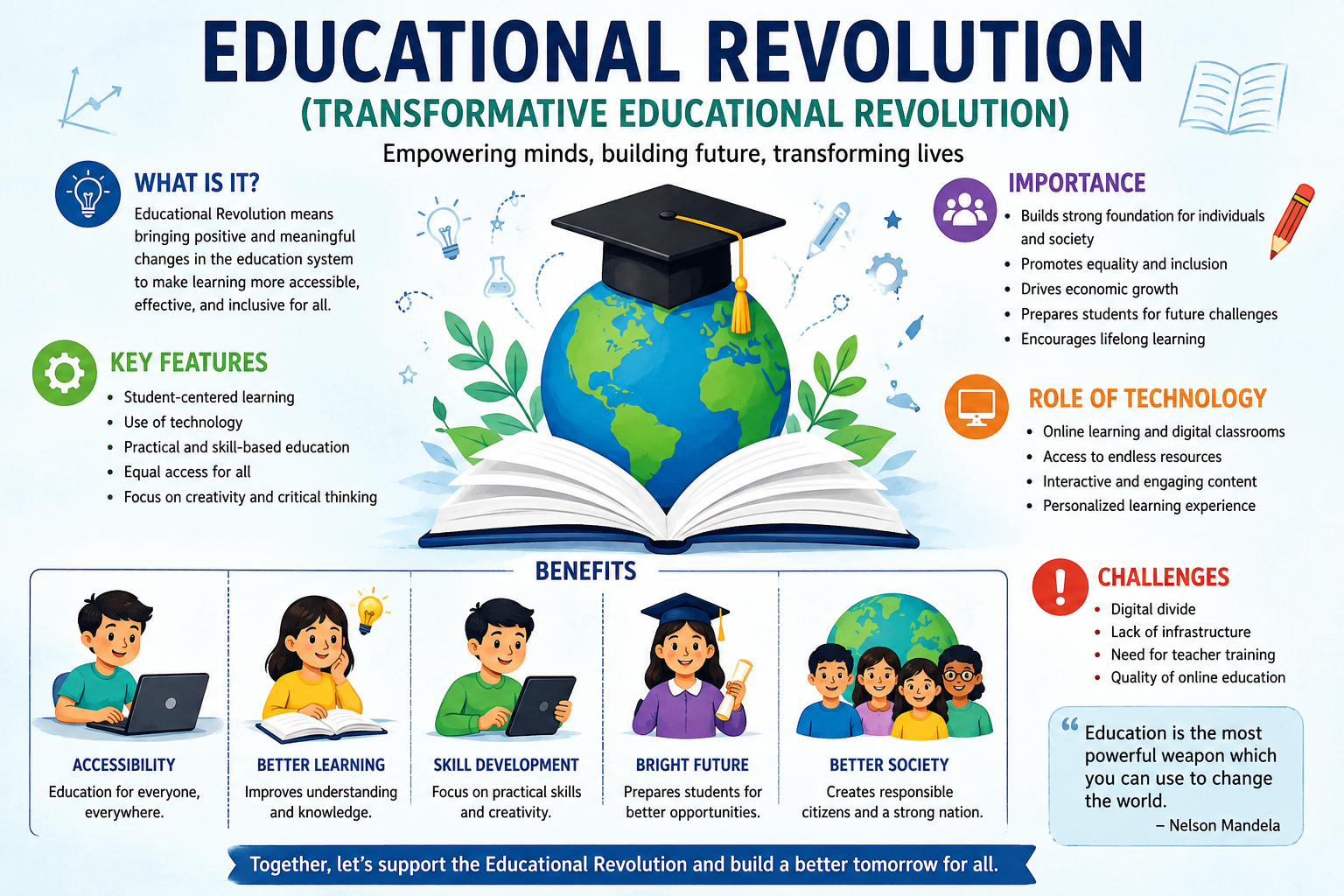
A transformative educational revolution refers to major changes in educational systems that make learning more accessible, effective, inclusive, and practical. It aims to prepare students not only for examinations but also for real-life challenges and opportunities. By integrating technology, innovative teaching methods, and student-centered learning approaches, educational revolution is shaping a brighter future for learners across the world.
Meaning of Educational Revolution
An educational revolution is a significant change in the structure, methods, and goals of education. It involves moving away from traditional learning practices that focus mainly on memorization and examinations toward a system that encourages understanding, creativity, problem-solving, and practical application of knowledge.
In the past, education was largely limited to classrooms, textbooks, and lectures. Today, students can access information from anywhere through the internet, online courses, digital libraries, and educational applications. This transformation has made learning more flexible and engaging than ever before.
Importance of Educational Revolution
Education plays a crucial role in the progress of any nation. A well-educated population contributes to economic growth, social development, and scientific advancement. The educational revolution is important because it helps improve the quality of education and ensures that learning opportunities are available to everyone.
One of the greatest benefits of educational transformation is accessibility. Students from remote villages and underprivileged backgrounds can now access educational resources through digital platforms. This helps reduce educational inequality and creates opportunities for millions of learners.
Furthermore, educational revolution promotes lifelong learning. In today’s rapidly changing world, individuals must continuously update their knowledge and skills. Modern educational systems encourage people to learn throughout their lives, helping them adapt to new technologies and changing job markets.
Traditional Education vs. Modern Education
Traditional education mainly focused on teacher-centered instruction. Teachers delivered information, and students were expected to memorize and reproduce it during examinations. Success was often measured by grades rather than actual understanding or skill development.
Modern education, on the other hand, focuses on student-centered learning. Students actively participate in discussions, projects, research activities, and collaborative learning experiences. The emphasis is placed on understanding concepts rather than memorizing facts.
Technology has also transformed learning environments. Smart classrooms, online resources, interactive simulations, and educational videos make learning more engaging and effective. Students can learn at their own pace and explore subjects according to their interests.
This shift from passive learning to active learning is one of the key features of the educational revolution.
Role of Technology in Educational Revolution
Technology is the driving force behind modern educational transformation. It has revolutionized the way knowledge is delivered and accessed.
The internet provides students with unlimited access to information. Online learning platforms allow students to attend classes from anywhere in the world. Educational apps help learners practice skills and improve their understanding of various subjects.
During the COVID-19 pandemic, technology played a critical role in ensuring continuity of education. Schools and universities shifted to online learning, allowing millions of students to continue their studies despite lockdowns and restrictions.
Artificial Intelligence (AI), Virtual Reality (VR), and Augmented Reality (AR) are further transforming education. AI-powered learning systems can personalize education according to individual student needs. Virtual reality can create immersive learning experiences, allowing students to explore historical sites, scientific concepts, and complex environments in ways that were previously impossible.
Educational Revolution and Student Development
The educational revolution focuses on the holistic development of students. Education is no longer limited to academic achievement; it also aims to develop social, emotional, and practical skills.
Modern educational systems encourage creativity, critical thinking, communication, teamwork, and leadership. These skills are essential for success in the twenty-first century.
Project-based learning and experiential learning help students apply theoretical knowledge to real-life situations. Instead of simply reading about scientific concepts, students can conduct experiments and engage in practical activities. This improves understanding and retention of knowledge.
Furthermore, educational transformation encourages curiosity and innovation. Students are motivated to ask questions, explore ideas, and develop solutions to real-world problems.
Educational Revolution in Rural Areas
One of the most significant achievements of educational revolution is its impact on rural and underserved communities. Traditionally, many rural areas lacked adequate educational facilities, trained teachers, and learning resources.
Today, government initiatives and digital technologies are helping bridge this gap. Online education, mobile learning applications, and digital classrooms are bringing quality education to remote regions.
Students in rural areas can now access the same educational content as students in urban centers. Scholarships, free educational resources, and government programs further support educational inclusion.
Although challenges such as internet connectivity and infrastructure still exist, the educational revolution has created new opportunities for learners in previously disadvantaged communities.
Role of Teachers in Educational Transformation
Teachers remain at the heart of the educational revolution. While technology provides valuable tools, effective teaching still depends on skilled and dedicated educators.
The role of teachers has evolved from being mere providers of information to facilitators of learning. Modern teachers guide students, encourage critical thinking, and create engaging learning environments.
Professional development and training programs help teachers adapt to new technologies and teaching methodologies. By continuously improving their skills, educators can better support student learning and success.
A good teacher inspires curiosity, builds confidence, and helps students discover their potential. Therefore, teachers play a vital role in ensuring the success of educational transformation.
Educational Policies and Reforms
Many countries have introduced educational reforms to support transformative learning. These reforms aim to make education more inclusive, flexible, and skill-oriented.
In India, for example, the National Education Policy (NEP) emphasizes conceptual understanding, multidisciplinary learning, skill development, and critical thinking. Such reforms seek to prepare students for future careers and global challenges.
Educational policies also focus on improving access to quality education, reducing dropout rates, promoting digital literacy, and encouraging innovation in teaching and learning.
These reforms demonstrate the commitment of governments and educational institutions to creating a more effective and equitable educational system.
Challenges of Educational Revolution
Despite its many benefits, the educational revolution faces several challenges.
One major challenge is the digital divide. Many students still lack access to reliable internet connections, computers, or smartphones. This limits their ability to benefit from digital learning opportunities.
Another challenge is ensuring the quality of online education. While technology provides access to information, effective learning requires proper guidance, interaction, and assessment.
Teacher training is also essential. Educators must be equipped with the skills needed to use modern technologies and implement innovative teaching methods.
Additionally, educational institutions must address issues such as data privacy, cybersecurity, and the responsible use of technology in learning environments.
Overcoming these challenges is necessary to ensure that the benefits of educational transformation reach all learners equally.
Future of Education
The future of education is likely to be even more dynamic and technology-driven. Artificial Intelligence, machine learning, virtual reality, and other emerging technologies will continue to reshape learning experiences.
Personalized learning will become more common, allowing students to learn according to their individual abilities, interests, and learning styles. Educational systems will place greater emphasis on creativity, innovation, entrepreneurship, and problem-solving.
Global collaboration will also increase. Students from different countries will be able to learn together through virtual classrooms and international educational programs.
As the world continues to change, education must evolve to prepare learners for new opportunities and challenges. The educational revolution is paving the way for a future where learning is more accessible, engaging, and effective than ever before.
Conclusion
The Educational Revolution represents one of the most important transformations of the modern era. By integrating technology, innovative teaching methods, and student-centered approaches, it is changing the way knowledge is acquired and applied.
This revolution has made education more accessible, inclusive, and relevant to the needs of contemporary society. It empowers students with the skills, knowledge, and confidence required to succeed in a rapidly changing world.
Although challenges such as digital inequality and infrastructure limitations remain, the benefits of educational transformation far outweigh the obstacles. With continued investment, innovation, and commitment, educational revolution can create a future where quality education is available to every individual.
Ultimately, education is the foundation of progress, and a transformative educational revolution is essential for building a more knowledgeable, prosperous, and equitable society. Through collective efforts, we can ensure that education continues to inspire, empower, and transform lives for generations to come.